
oh, the humanity {1}:
pizza tour
1.0: fear & loathing in hunger
written by: j.money allen, 2025
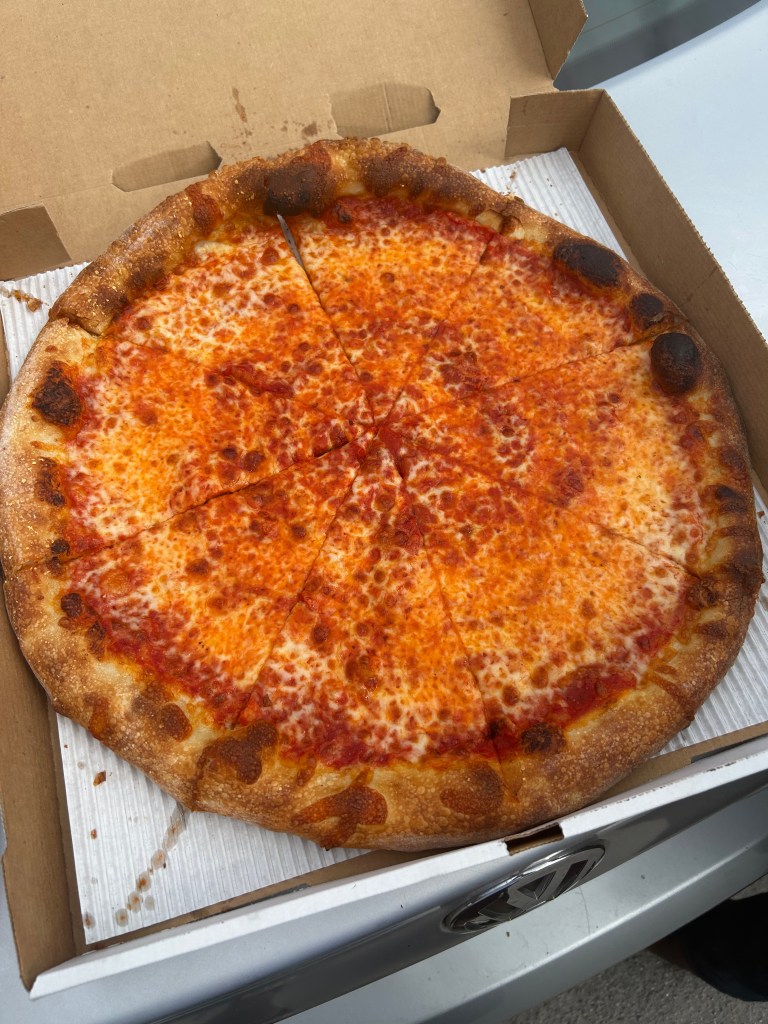
I love pizza – but sometimes, not too often, I actually hate pizza – yin and yang. Pizza & I are certainly a true love – often one sided, rarely and reluctantly available for a serious conversation but always willing to touch, be touched – eat and be eaten. Pizza sits right at the intersection of my inner child’s curiosity and my grown-up haze of lived experience: a large majority of that being spent in front of and often partially inside of a piping hot pizza oven. I have a drive to eat and think about pizza but also a standing invoice for the years of my life sacrificed at the altar of our lord and saviors “tomato bread.” To put it another way, my heart is the freaking Teenage Mutant Ninja Turtles eating sloppy pizza every night in their hole underground watching cartoons while my brain is the sweatiest, most tired person you can imagine covered in semolina flour and their own blood leaning over an Avantco APPT-71-HC stainless steel pizza station sobbing into their palm. Yin and yang. In an effort to put all those years of eating, making, sweating, bleeding and crying pizza-shaped tears to good use, I’ve decided to declare war on all of the pizzas I have yet to eat. A tour of duty – a Pizza Tour – wherein my brother & I gather in a ritual of sacrifice offering our wallets and our tastebuds to the governing bodies of the cosmos; sampling a large cheese pizza from all of the local and surrounding pizza joints and reporting our findings. Each pizza will have its photo taken before we partake and will then receive a score out of 100 based on their performance.
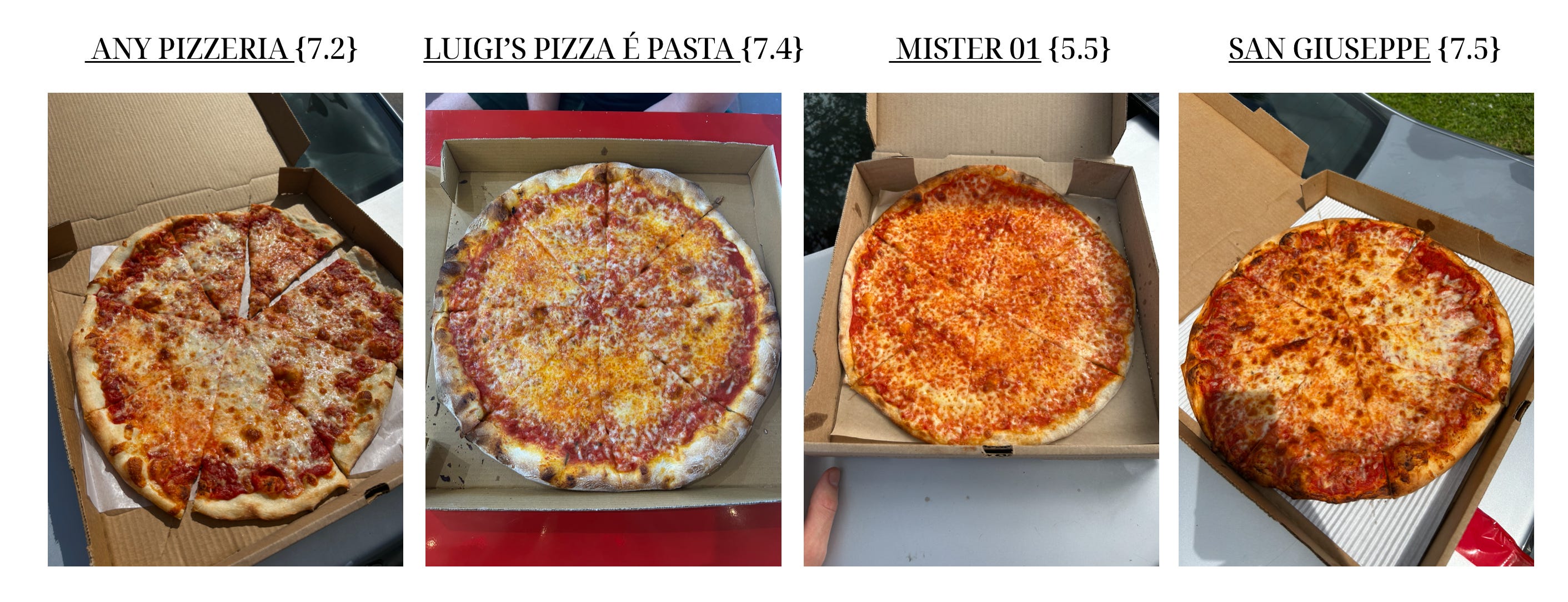
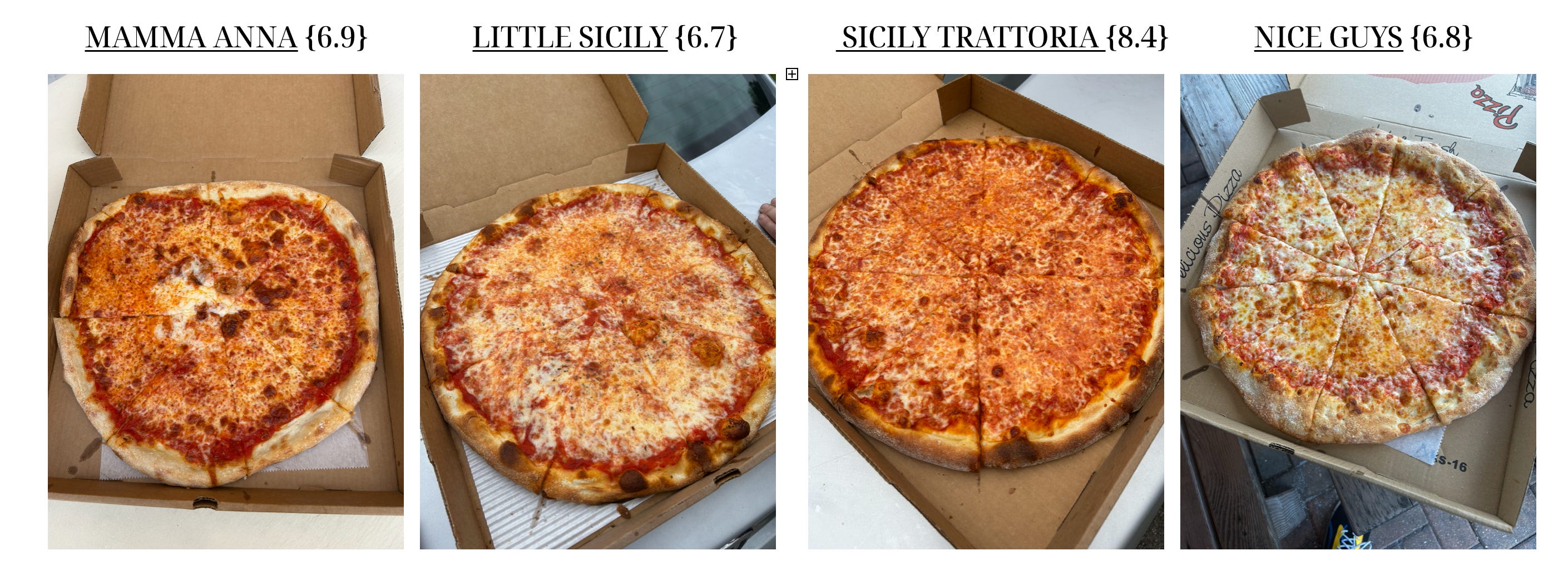
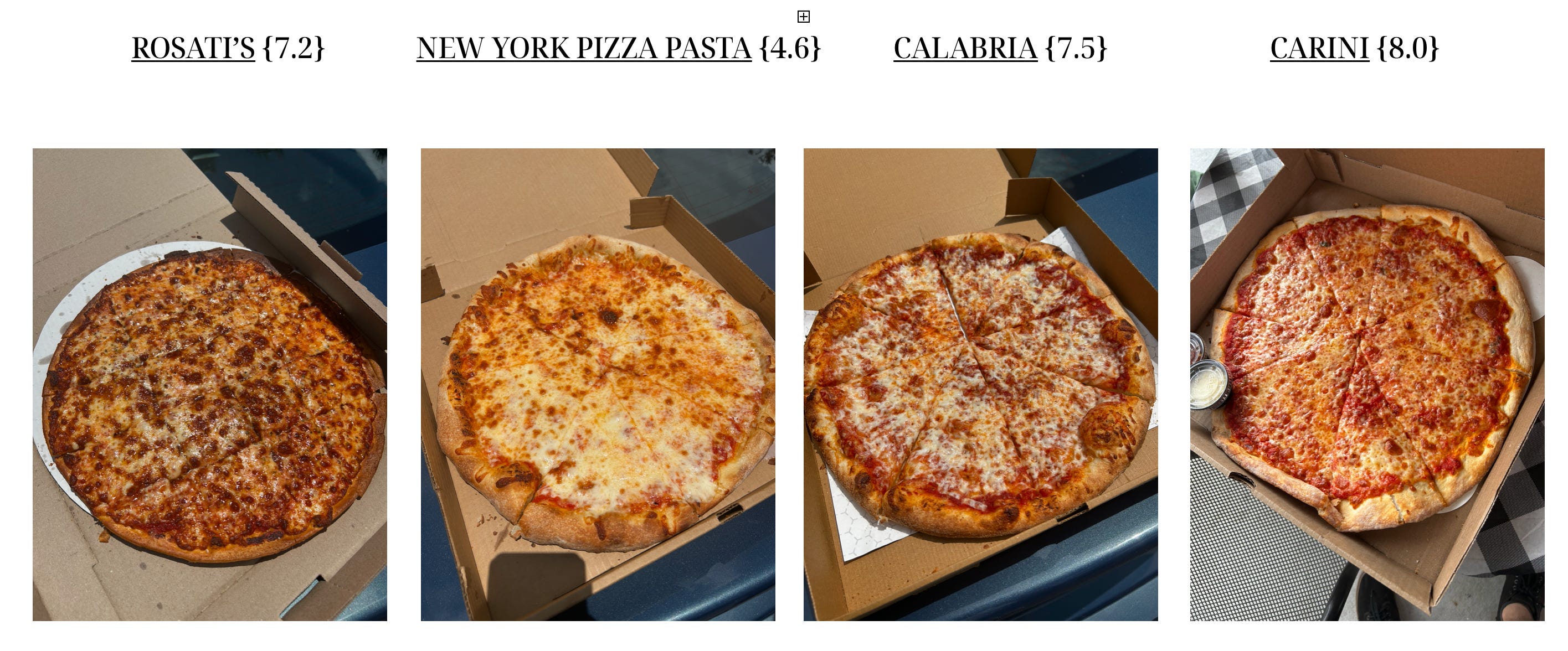
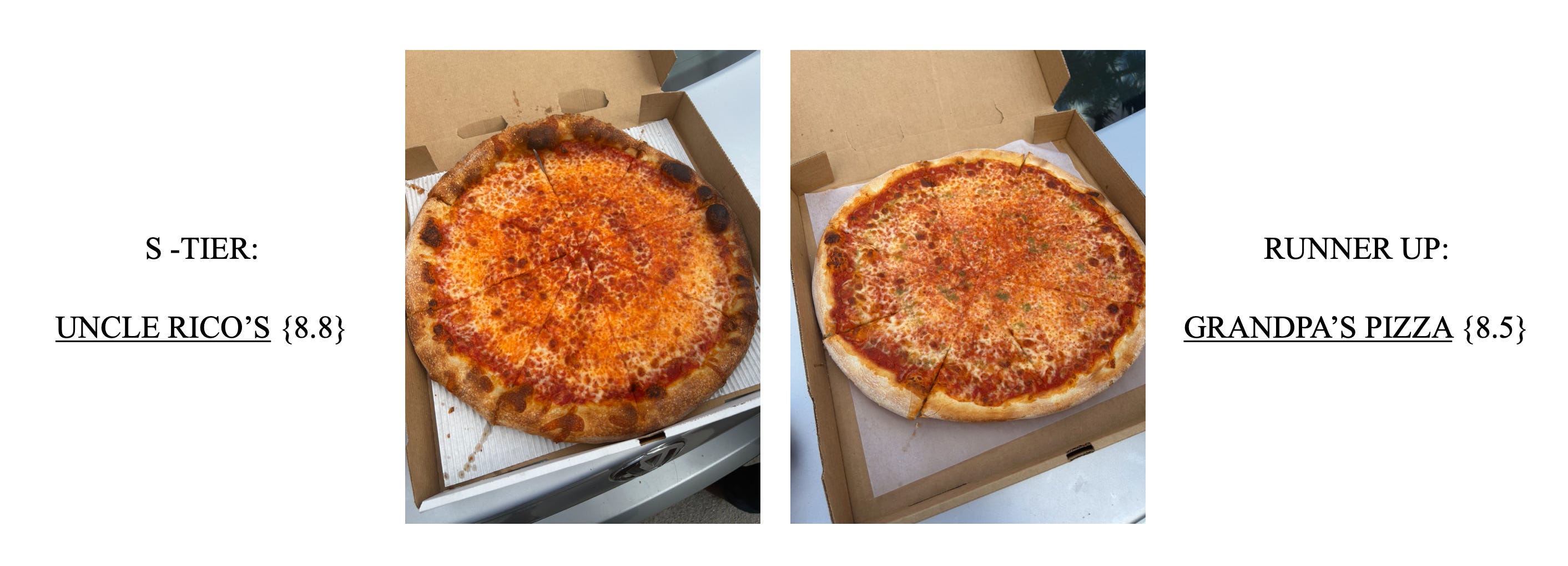
During these tours, a few things started to occur to me as broad commonalities between not only the places we visited during our conquest but the places seen from the inside looking out prior to our enlisting. Firstly, the best pizzas always came out of the kitchens with seemingly the most to lose. Grandpa’s Pizza, Uncle Rico’s, Calabria – the least amount of staff possible, most of them being family members, all focused on the goal of making a good product and paying the rent. Like most things in this capitalist fever dream we’ve woken up to, the more money that gets pumped into an operation the worse the product becomes. Every place we visited that impressed on the surface with fancy menu-speak and clean, modern decors came out the other side with a product that was either not very good or laughably far off of the mark – Mister 01, New York Pizza Pasta, Little Sicily. There does seem to be a strict skill floor set to a “please be more than one person” requirement for any pizza place to function with any sense of urgency or quality. Surprisingly common but rarely effective, one person and their two dangling hand-tipped-pencils is just not enough to get all of the chores done for pizza – whether that’s the day-to-day back and forth of sweating over the cash register and pizza station in equal measure, or the base level discussions about product quality and inventory requirements: somewhere, somehow, something is burning outside of your purview and by the time you get the fire extinguisher to get everything under control, you’ve let four other fires start and now there’s no turning back.
To say the pizza industry can be unforgiving is an absolute understatement – a simple ingredients list and potentially high profit margins seemingly force the hand of rich, apathetic nepo-babies looking for a little hobby business to get registered before their grounded with no Amex allowance for a week. This creates a dizzying miasma of options for customers and a source of deep-pocketed competition for local, trusted dealers – a single false move, one mediocre pie served to the wrong influencer and suddenly your life and business are in shambles. Some of it surely comes down to regular business ignorance – poor people with delusions of investor capital and smooth sailing slamming face-first into a wall of consumer indifference and general market misfortune – but I also think the widespread distribution of the pizza virus amongst the eating population has simultaneously raised and lowered standards for what makes a pizza “good”. Leading to a market saturated with consumer ignorance and targeted ads designed to radiate and spread this ignorance as a weapon against small businesses via flashing lights and large text fonts.
Now, what we’re about to do is very nuanced and will require a little prefacing: what is good and what is bad when it comes to food is half subjective and half objective. Unlike other art forms like music or film, where the boundaries of what is acceptable on a technical, medium-wide level are able to be teased, tested and expanded – envelopes being pushed open and torn asunder – when it comes to food, there’s an ever present layer of science going on behind every single dish you bear witness to and breaking through that layer can only result in things that are “not good”, objectively, scientifically, biblically. There’s the kind of base, periodic table level of science going on with food (salt, fat, acid, heat – etc.) and then there’s the kind of genre-specific sciences (ratios for meringue, cooling and cooking times for pastry, proofing times for different styles of pizza dough in different climates, etc.) – and they all combine in a brain dance with human spirit and creativity to create something actually, completely, scientifically “good”.
You can make a bland meringue with a perfect texture and form, you can make a tasty pastry filling wrapped in a crust that can’t hold it’s shape, and you can arrive at a pizza with delicious toppings and complex flavors held together by a crust that doesn’t cook through at the same time as everything else because it didn’t proof long enough (goddammit). The pendulum activates, and you can also have foods that do exactly what they’re supposed to by science and by God but taste exactly how they should never taste for any reason. Lets look at Little Cesar’s for example – scientifically, it’s “good” – a process and product was solidified over years of iteration at a molecular level to come out cooked and clean every single time – but science is only half the battle. To some, the process itself creates an artificial flavor that seeps into every aspect of the pizza – making it lack depth and taste “plastic-y”. To others, they might not perceive this artificiality and just having a pizza that’s cooked and proportioned properly is good enough for them. No shade to either camp: I, too have enjoyed slapping a fiver to the cashier in exchange for a large cheese pizza that I will dip in ranch when I get home – but I would hesitate to call this eating experience “good” even if it does exactly what it says on the tin. I think there’s a grander conversation to be had about the cheapness of processed foods and the “enshitification” of those foods throughout recent history and how that can distort people’s perception about what makes “good” food actually good – but I think we’re here to talk about pizza?
So, on one hand – the grand processing and commodifying of pizza has raised the scientific standard for a “good” pizza in the eyes of the populous – while on the other, this same process has sacrificed a heaping load of flavor and tradition in favor of a convenience that fills the neurological role of making the food tasty to us. “Yeah, the pizza isn’t great but it kind of tastes like the fifteen dollars I didn’t have to spend on it, so I’d say it tastes pretty good.” This is an illness of the mind, undoubtedly – and I am not even close to a doctor – so I just wanted to bring it up as it plays an important role in how I personally rate the pizzas presented on a given Pizza Tour.
Some of the points allotted are based entirely on this value/science ratio that most single parents will be looking at when they’re trying to feed themselves and their two children for less than thirty dollars on a Thursday night. Back to our Little Cesar’s example; if I had to give a score to a large Little Cesar’s cheese pizza right now, which I can only taste via whichever lobe of my brain is responsible for housing painful memories, the score would be a 5.2. The pizza works so I can’t argue with the science of it and the value kind of speaks for itself – so despite not tasting very good and the cheese being too greasy, it doesn’t get a terrible score. This is the baseline for all scores given out during the Pizza Tour – if it gets below a five or a four then we are talking about a pie that is biblically, logistically, scientifically “not good.”
In addition, I’d like to note that we pick these pizzas up in person after placing an order over the phone en route to the restaurant – and this experience absolutely gets factored into the score. If we call and have to click through a robo-directory for five minutes that asks if I want to set up a rewards account before I’ve even spoken to a host, that’s points off. If you give me a time frame for the pizza to be ready and it takes twice as long but your restaurant is obviously the opposite of busy, that’s points off. If you give me a time frame but it takes a couple extra minutes and we stand at the counter as you tell me stories about the restaurant and you’re beautiful chihuahua who recently passed away, that’s extra points. All I’m asking for is a little decency to go with my pizza. It’s a communal food served communally so it’s best when it comes from within a community.
“In order to be truly exceptional, of course the food has to be exquisite – but most importantly, your hospitality must be overwhelming.” – Donnie Madia. You get what you give and if you give me an overwhelmingly human experience in your restaurant – not looking for proper & uniform – then I will have simply no choice but to view your pizza as something more than science: something human. Call me old fashioned, but as the world tries to violently disconnect us from the things that make us human – entering a restaurant only to submit your order into a monolith-shaped screen housing both the restaurants menu and your disappointing reflection – I’ve grown to appreciate even the smallest levels of genuine human interaction.
We race through our lives, drooling into glass rectangles, being advertised this technological appendage as a means for more connection opportunities – bringing the entire globe into your pocket along with myriad ways to access it and mine it for gold. I don’t think I’m breaking any new ground by saying that this has, in fact, done the opposite. Plenty of drivel has been spilled as to the why and how of us arriving at this point, but I think that we essentially have sacrificed the care & attention of the people within our own communities for the perceived opportunity that care & affection will come from the world outside of those communities. This combined yearning and disregard has seeped into almost all human interactions – basic, time-honored niceties & creature comforts pushed to the side while argument wars are waged in forums and comment sections the world over about whether or not it’s worth the effort and time to be nice to other people – the dog-eat-dog neurotoxin working exactly as intended.
I understand that I might be a bit too young for the whole “back in my day” big unc talk, but as someone born right on the cusp of millennial-ness, I feel I’ve had the distinct misfortune of watching the world change around me. (Another thing to add to the forbidden list of “things I have in common with my father”). Present enough during the pre-iPhone times to remember what it’s like to never be bored by anything but also high-functioning and able to use a computer from a very young age. Unfortunately, this perspective doesn’t offer me any great insight into how we break this sleek, modern and freshly updated vicious cycle – hurt people hurting people just like before now faster and less personal – but instead, a great longing; a desperate nostalgia for a world twenty or so years removed from the world we are in now. A world where you weren’t psychologically pinned into propagandizing algorithms spewing stolen artwork and computer generated rice cooker recipes. A world where you sat in a big room with dozens of other people and watched a whole movie without once feeling the urge to pull a screen out of your pocket and watch a thousand ten second advertisements instead. A world where you weren’t vaporized daily by a singularity of existence where everything everywhere happens all the time making sure that nothing ever really happens as we move on from it all so quickly.
The great common denominators among us – this feeling that the world we live in is needlessly accelerated, commercial & disconnected, coupled with the agonizing physical discomfort of wishing you were eating some pizza right now (fear, hunger). We all have such similar wants and needs while unanimously navigating a world that puts so many artificial barriers between us and those needs, spinning around to eat its own tail & becoming a denominator in itself – the need to escape (loathing).
The hospitality, the humanity, is a huge factor for me – in all things, sure – but especially when it comes to food and extra especially when it comes to pizza. You never see the person who makes your chicken sandwich at Wendy’s and I think that’s okay, there’s room for that – I’m sure they’re lovely people and blah blah class warfare blah blah workers unite, you get it – but there’s such little variation between each chicken sandwich; there’s no room for any expression on behalf of the person making it. This is by design, of course – the easiest way to make sure every person on the planet receives the same product is to streamline the production so there’s no possibility for human error or customization. We see this in pizza as well – the aforementioned Little Cesar’s, Blaze Pizza or some of the bigger chains like Pizza Hut – with their frozen, pre-shaped dough discs and pans escorted through conveyor belt ovens ladled over with precision spoons for consistent measurement – this business logic is tangible, edible. Pizza made by hand is such a different beast. Each pie ordered in a sequence may use the same dough and the same toppings and be cooked in the same oven by the same person wielding the same paddle used as the previous one, but each comes out just the slightest bit differently. This is the human cost of pizza – the callous hands that had to slap the pizzas’ dough out onto the counter, maybe throwing it in the air like they do in the movies, the hours of prep time waiting for the dough to be perfectly proofed – each ingredient and each step in the process laced with the inherent creativity and lived experience of the people who made it.
This sense of boots-on-the-ground humanity; this togetherness with the world around it, I think is where a lot of pizza business fail. As a business taking up physical space in an area, you’re entrusted with a very serious responsibility: you either participate in and uplift the community that’s there or you create a community of your own in one’s absence. Taking an interest in the things going on within the area surrounding your restaurant should be an essential step when deciding to even open a business in the first place. If you can believe it, restaurants are actually businesses and often have access to or can generate resources within a community: financial, environmental or otherwise. Steady employment for community members, access to fresh and clean food prepared safely or in some cases even just a plain old safe and comfortable place for the community to gather. These are your quiet responsibilities, the pleasures that go without saying – imperceptible in their natural, human resonance but absolutely heart breaking when felt as absent. Punching above these responsibilities sees your business taking charge of community representation: donating to local charities or food banks, hosting local events or artists, sponsoring a local sports team, catering lunch for emergency workers – there are myriad options for meaningful community engagement waiting to be tee-d off, you just have to commit to the swing from day one because everyone can tell when you’re faking it – just like you’re doing now (I see you).
You can read this as just sound business strategy, and you’d be correct in doing so – you want people to know about your local business, best to meet the locals where they’re at. Yet so many times, I’ve seen places pop up in our rapidly expanding area; all pretty logos, branded boxes and fancy dining rooms – no community engagement, no family connections to local groups just *plop* new thirty dollar medium pizza opened up down the road – everyone asks about it but has never been, parking lot always empty. You only get one chance to make a first impression & there’s a stark contrast between the resulting outcomes when engaging in the community versus trying to farm them for cash. It feels simple, I know; but making yourself a pillar of the community is the single most effective marketing strategy in existence. It takes a long time to get right but barring a full societal collapse, it will keep your business afloat for a very long time. Like we eluded to earlier, you can plunder the depths of social media marketing and come out the other side with a bunch of views on TikTok and lines spilling out the door onto the street every morning but they won’t be packed in with local meat skeletons as these here be globally outsourced meat skeletons waiting a full hour in line to get a taste of that Dubai chocolate pizza (gross).
Taking this route steps right over the people around you – the people in your community, that you see on the way to work every day – who never got the opportunity to earn your trust & are now forced to think of your restaurant as the place they have to avoid on their way to work because the sidewalk is too crowded with rude people sucking their glass-rectangle pacifier, taking up space. What can be tough for some to realize is that the people that let the algorithm tell them what to do and where to eat are always going to end up somewhere else eating a shinier kind of chocolate – a mission from their master – and any of the #momentum you might have gained from bugging your line cooks to film Instagram reels will wain as you lose that sheen of newness, of trendiness, & copycats rise from the ground to undercut you and suck it all dry – the American dream. It’s the community that will keep your business alive, rain or shine. If you’ve participated in and uplifted the community; fed them food, attention, paychecks and kindness; they will return the favor in kind. They won’t line up down the street for ya because they all have shit to do but they will help keep the lights on when everything is going wrong: you’ve fired your socials manager for posting about his foot fetish on the business Instagram and your deep fryer flooded so you’re only able to make half of the menu items and your sous chef slipped and broke their arm last week on a mess that they made and is trying to sue you while also not being able to work and the fire code inspector is on their way – the community will pile in and help you clean up the mess.
So, what I’m saying is that being approachable and humble will get you a long way in the pizza business – the best places pair the customers human experience with the products consistency. The product should be consistent and consistently excellent not because it’s a surefire way to make easy money (it’s not and it’s not easy) but because you can relate to the person on the receiving end of the pizza box and what kind of experience they’re looking for. Because they’re members of your community and they shouldn’t have to choose between convenience, quality or cost – these factors should all be working together to make the best possible product for the people you’re serving it to.
And that’s why Uncle Rico’s is the highest rated pizza in Southwest Florida. (as of 2025)
- frog forest records dot net
- forever
 frogforestrecords.net